Empires Mirror // Echosystems of Code and Flesh
Machine oracles conjure speculative ecologies woven from code and memory. Sacred maps glitch and breathe in dialogue with our digital doppelgängers. Queer aesthetics, indigenous futurisms, and hallucinated archives entwine across boundaries, tracing how generative AI – empire’s mirror – dreams of preservation even as the planet trembles beneath our collective dance.
Participating Artists: Lorelei d'Andriole, Michael Borowski, Karl Erickson, Edgar Fabián Frías, Eddie Lohmeyer, Michael Mersereau, Freya Björg Olafson, Dana Potter, Drew Sisk, Sarah Turner
Pavilion organized for the Wrong Biennale 2025/26. Online November 1, 2025 - March 31, 2026
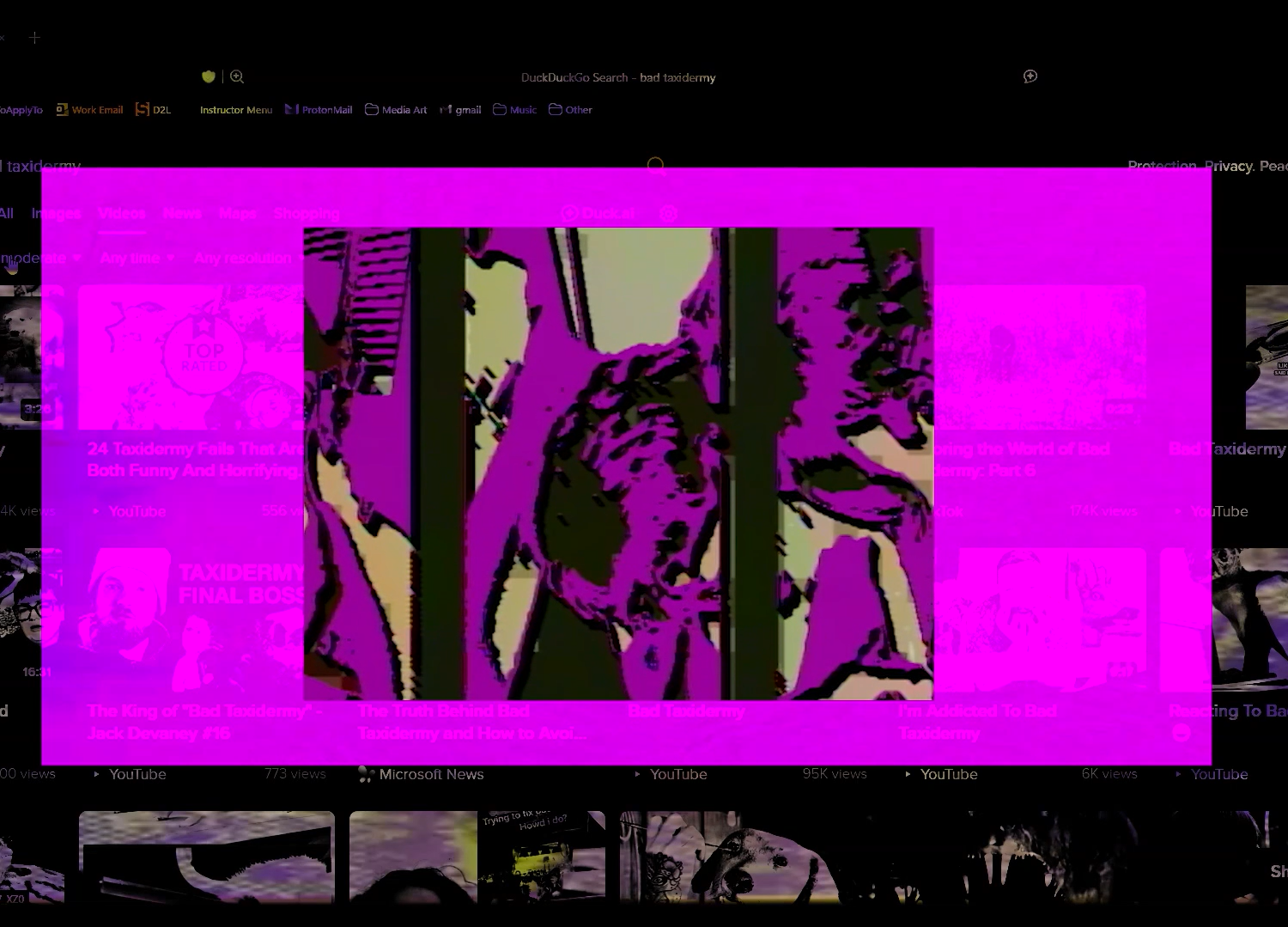
Bad Taxidermy // Lorelei d’Andriole
Project Statement:
"Machines have the morality of their inventors" - Amiri Baraka, 1970
In 2023, while in residence at the Institute for Electronic Art at Alfred University, I began to experiment with creating AI generated animations exploring subjects within transgender studies. The animations that were produced were like bad taxidermy - a comical failure of capturing reality. AI Art, like bad taxidermy, delights us in its abject failure. However, we must not forget the literal blood and bones upon which both media draw upon. All art media have a political history and the political history of new media is uniquely being used in our moment to prop up the ruling class. AI Art is perhaps the most clear in its expression of empire, as the production of AI Art includes the theft of intellectual material, destruction of natural resources, and raising massive sums of money for corporations. Regardless of how we might use AI in art or in the classrooms, we must hold the dialectic that whatever accessibility features, delight, or conceptual academic milieu it offers us that Machines Have the Morality of Their Inventors.
Artist Bio:
Lorelei d’Andriole (she/her/hers) is an artist, educator and writer whose work is at the intersections of intermedia and transgender studies. Born in Oklahoma City, Oklahoma, d’Andriole toured across the country in punk bands and played hundreds of shows in venues ranging from house shows to amphitheaters before entering the academic world. d’Andriole earned her BFA in New Media from the University of Central Oklahoma (Magna Cum Laude) in 2018 and immediately went on to earn her MA and MFA with honors from the University of Iowa’s Intermedia program. In 2022, d’Andriole completed a visual arts fellowship at the Leslie Lohman Museum of Art in New York City, NY and currently works as an Assistant Professor in Electronic Art and Intermedia at Michigan State University. d’Andriole served as a board member for the International Alliance for Women in Music where she advocated for queer and trans* composers and musicians between 2022-2024. She has completed artist residencies at Public Space One in Iowa City IA, A.P.E. in East Hampton MA, Signal Culture in Loveland CO, Wave Farm in Acra NY, and the Institute for Electronic Art at Alfred University in Alfred NY. She has published scholarly articles on sound studies and transgender studies in the Media-N Journal and Resonance: Journal for Sound and Culture and has shown work nationally in galleries, universities, media and film festivals, and DIY spaces.
THE WOODEN BEAVER ARCHIVE // Michael Borowski
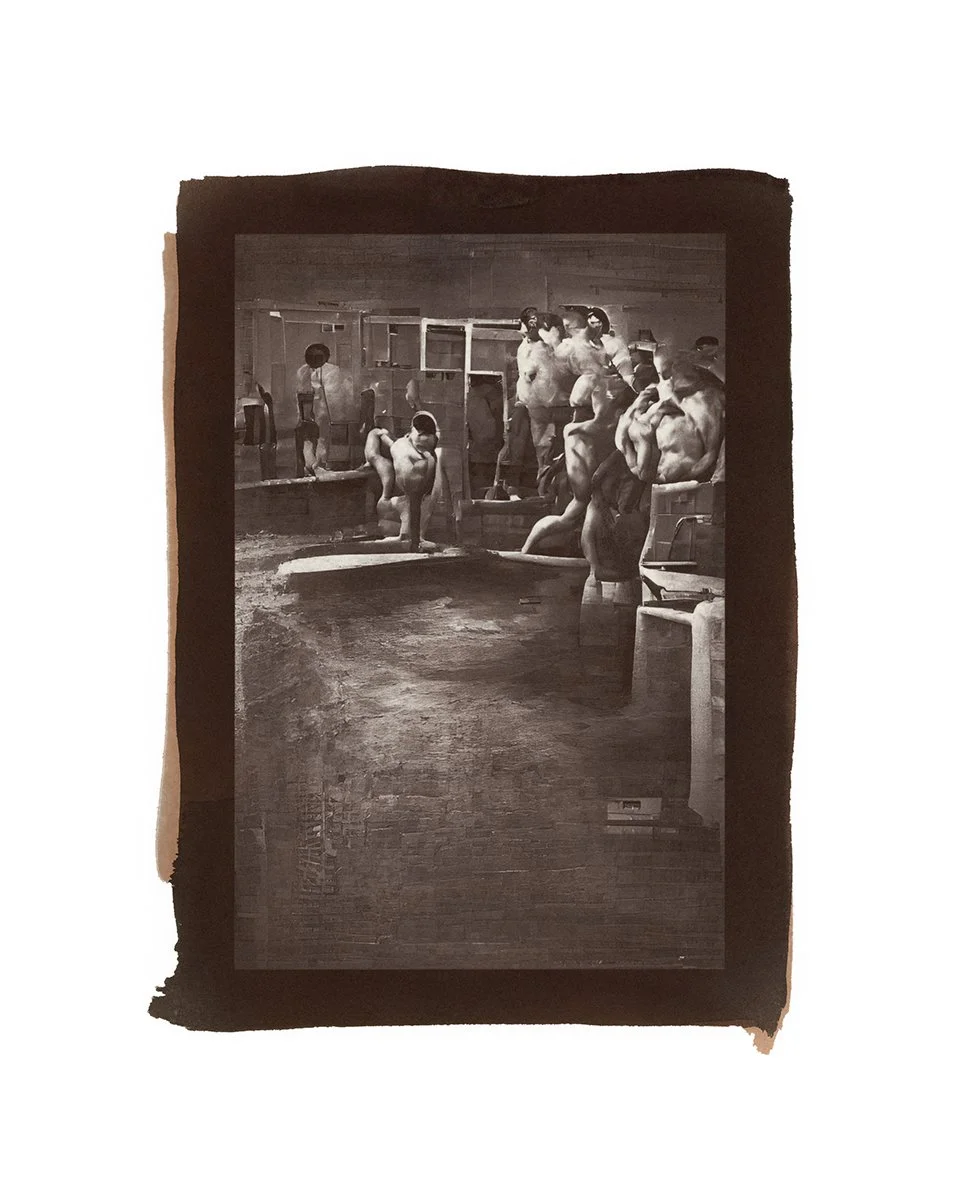
The Wooden Beaver Archive document 0646 (Steam Room). Salt Print (AI-Generated Image), 10 x 8 inches, 2022
Artist Bio:
Michael Borowski (b. 1981, Boston) is an artist and educator whose work reimagines queer histories and counternarratives of Appalachia and the American South. Based in southwestern Virginia, where he serves as an Associate Professor of Photography at Virginia Tech, Borowski works with an expanded photographic practice. His multidisciplinary approach combines elements of fact and fiction, documentary and science fiction, to construct visual narratives of histories that were systematically undocumented or actively repressed.
A 2022-23 Virginia Museum of Fine Arts Fellowship recipient and Graham Foundation grantee (2019), Borowski's work investigates the intersection of place, identity, and historical representation. He has completed residencies at Signal Culture, Millay Colony, Elsewhere, and Est Nord Est. His work has been exhibited internationally, including at the Museum of Photography (Berlin), The New Mexico Museum of Art, The Virginia Museum of Contemporary Art, the Czong Institute of Contemporary Art (South Korea), Espace Projet (Montreal), Candela Gallery (Richmond), and Soho Photo Gallery (NYC), among others.
Borowski holds an MFA from the University of Michigan and a BFA from the University of New Mexico. His current research explores environmental and cultural impacts of technological infrastructure on rural communities, continuing his commitment to uncovering overlooked histories and reimagining possible futures.
Project Statement:
This series of salt prints is a speculative archive documenting a fictional mineral spring called “The Wooden Beaver”. I began by researching 19th Century mineral spring resorts throughout Virginia and West Virginia, where wealthy White southerners came to “take the waters” for their believed medicinal properties. These resorts played a significant role in American leisure and health, though few remain. I was curious about historical connections between mineral springs and gay bathhouses, but was unable to find records of queer activities from this time and place.
This project imagines a lineage between mineral springs and bathhouses as sites of queer desire and belonging. Uncovering these histories requires speculation, as LGBTQ+ affiliations were often expressed through code and nuance. Jose Esteban Munoz writes in Cruising Utopia, “Historically, evidence of queerness has been used to penalize and discipline queer desires, connections, acts.” I worked with AI software because 19th Century queer histories are generally unarchived. Rather than accepting these missing documents as proof of absence, I use generative technology to imagine alternative, undocumented histories. I then printed these AI-generated images using the salt print process, one of the most prevalent photographic techniques of the mid-19th Century, that bridges the sense of past and present.
My work emphasizes ambiguous forms as queer bodies and publics. The images are rendered in hazy, ambiguous compositions. The longer you look at them, the more their representational logic dissolves. This evokes both a cruising glance and the search for queer history. They work best when approached obliquely.
Oh, Are You One, Too? // Karl Erickson
Project Statement:
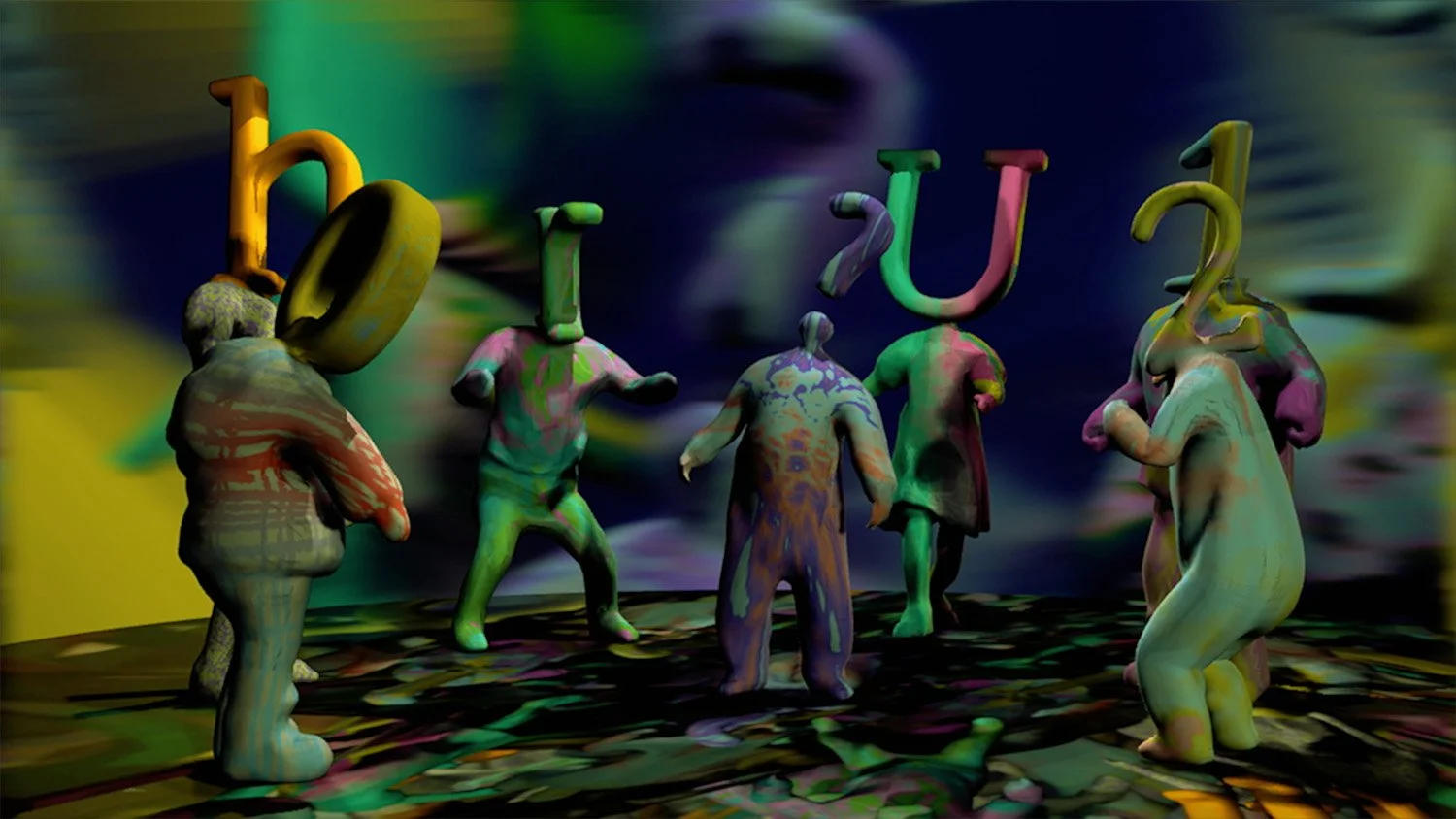
Letters, like lost children, try to find connections across boundaries and differences. They call out their individual letter names, coming together in a raucous, cacophonous song urging all weirdos to come together.
The animation is made by mashing together 3D models of children, letters, and numbers. The characters are animated with motion-capture data, and manipulated and assembled inside of TouchDesigner. The motion-captured animations are further augmented, distorted, and glitched by the sounds, creating a feedback loop with the sound and visuals, each effecting the other, an echo-system.
Artist Bio:
I make digital animations, videos, installations, and audio/visual performances. My screen-based work takes place in galleries, museums, film festivals, and music venues. My art is about recognizing the agency of all the other-than-human entities with which we share the Earth. This includes plants and animals, as well as machines, “inanimate matter,” electricity, waste, the macroscopic and the microscopic. The complex systems I use in my art-making, from photogrammetry to modular synthesizers to data analysis are analogous to the complexity of the ecosystem.
In my art, there is a breakdown in the established order of meaning, nonsense proliferates, and identities become unfixed. Recently, I have been creating semi-autonomous digital puppets made from 3D scans of trash. In order to figure out how to make them move, I have also been experimenting with live-action puppet shows.
I’ve been an artist in residence at Loop Art Critique, The Arctic Circle, Plyspace and Signal Culture. I received my MFA from California Institute of the Arts and BFA from Wayne State University. He lives in Memphis, TN where he is an Associate Professor of Digital Art at Rhodes College.
Haaca // Edgar Fabián Frías

Project Statement:
"Haaca" is the Wixárika word for "hunger."
This artwork combines sacred and cartographical traditions with modern elements like machine learning, indigenous futurism, queer aesthetics, and glitch art. It is a Nierika, a traditional Wixárika portal and map.
Artist Bio:
Edgar Fabián Frías is a boundary-defying multidisciplinary artist, educator, and brujx based in Los Angeles, holding degrees in Psychology, Studio Art, and an MFA in Art Practice from UC Berkeley. Drawing on their Wixárika lineage and informed by post-internet, queer, and glitch aesthetics, Frías creates immersive works that interlace technology, spirituality, and collective healing, deliberately unsettling conventional categories. Their practice investigates resilience and radical imagination through Indigenous Futurism, queer/trans cosmologies, and data justice, crafting portals that function as spells, maps, and mirrors. Through these works, Frías invites re-enchantment while conjuring futures grounded in justice, care, and magic.
Fuyu.02 // Eddie Lohmeyer
Project Statement:
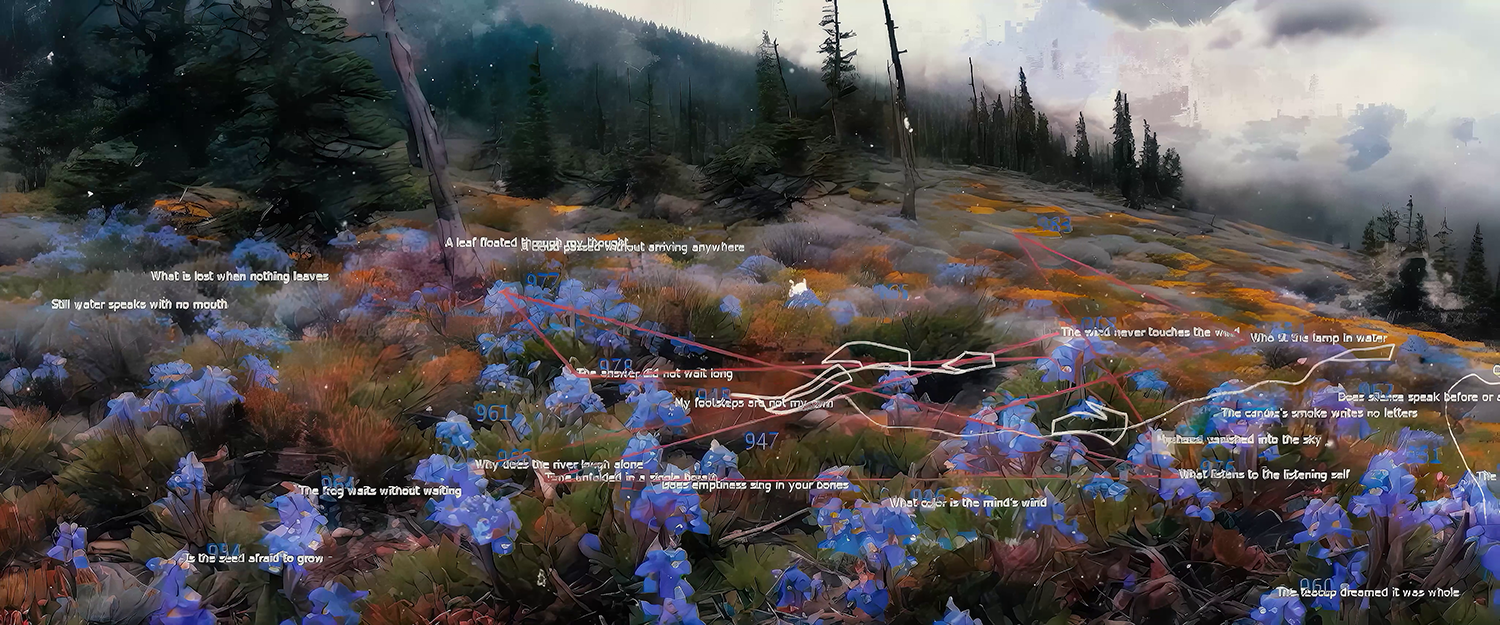
Fuyu.02 is a video work from the ongoing series terra_forms which explores novel ways in which glitch practices and artificial intelligence engines can visualize climate devastation while charting an ethics for using AI to address ecological disaster in our current Anthropocene. Produced from drone footage animated using datamoshing and AI diffusion models, Fuyu.02 imagines speculative ecologies of the Appalachian region that draw critical attention to climate change through concepts of terraforming; or rather, modifying a planetary body to make it habitable for human life. Here, I reconfigure terraforming not as a process of colonization rooted in hegemonic, anthropocentric flows of power and capital, but rather as an artistic practice of destructive generativity: one that reassigns agency to non-human animal, plant, and fungal intelligence. Drawing from 19th century panoramic technology, Ukiyo-e Japanese landscapes, and contemporary videogame aesthetics, Fuyu.02 expresses a future in which human DNA merges with flora, fauna, and fungus to produce a tightly-woven and nuanced symbiosis. Rather, terra_forms speculates on a future in which humanity has been subsumed into an Appalachian ecosystem, reclaiming nature through worldbuilding, ritual, and mythmaking.
Artist Bio:
Eddie Lohmeyer is an Assistant Professor of Visual Rhetoric and Information Design at Clemson University. His research and creative practice explore aesthetic and technical developments within histories of digital media. Using deconstructive approaches such as glitch and collage, his animations and video installations have been exhibited both nationally and internationally, most recently at Bucknell University Art Galleries, Milan Machinima Festival, Platform 101 Gallery (Tehran, Iran), and the Fotografisk Center (Copenhagen, DK). Drawing from pop culture debris, Buddhism, art history, as well as traditions of magic and the occult, Lohmeyer’s art explores intersections of digital worldbuilding, speculative ecologies, and modes of spiritual reflection to think through environmental futures that counter global inequalities and the climate devastation of late capitalism. Through experimental animation and the vibrancy of kinetic digital forms, Lohmeyer uses glitch practices and artificial intelligence engines to imagine alternative worlds that decenter the human and value emergent forms of plant and animal intelligence. Imagining glitch and error as a process of generative reincarnation, his work explores future possibilities for ecological symbiosis among human and nonhuman bodies through expressions of alternative cosmologies, ritual, and mythmaking.
Interview // Michael Mersereau
Project Statement:
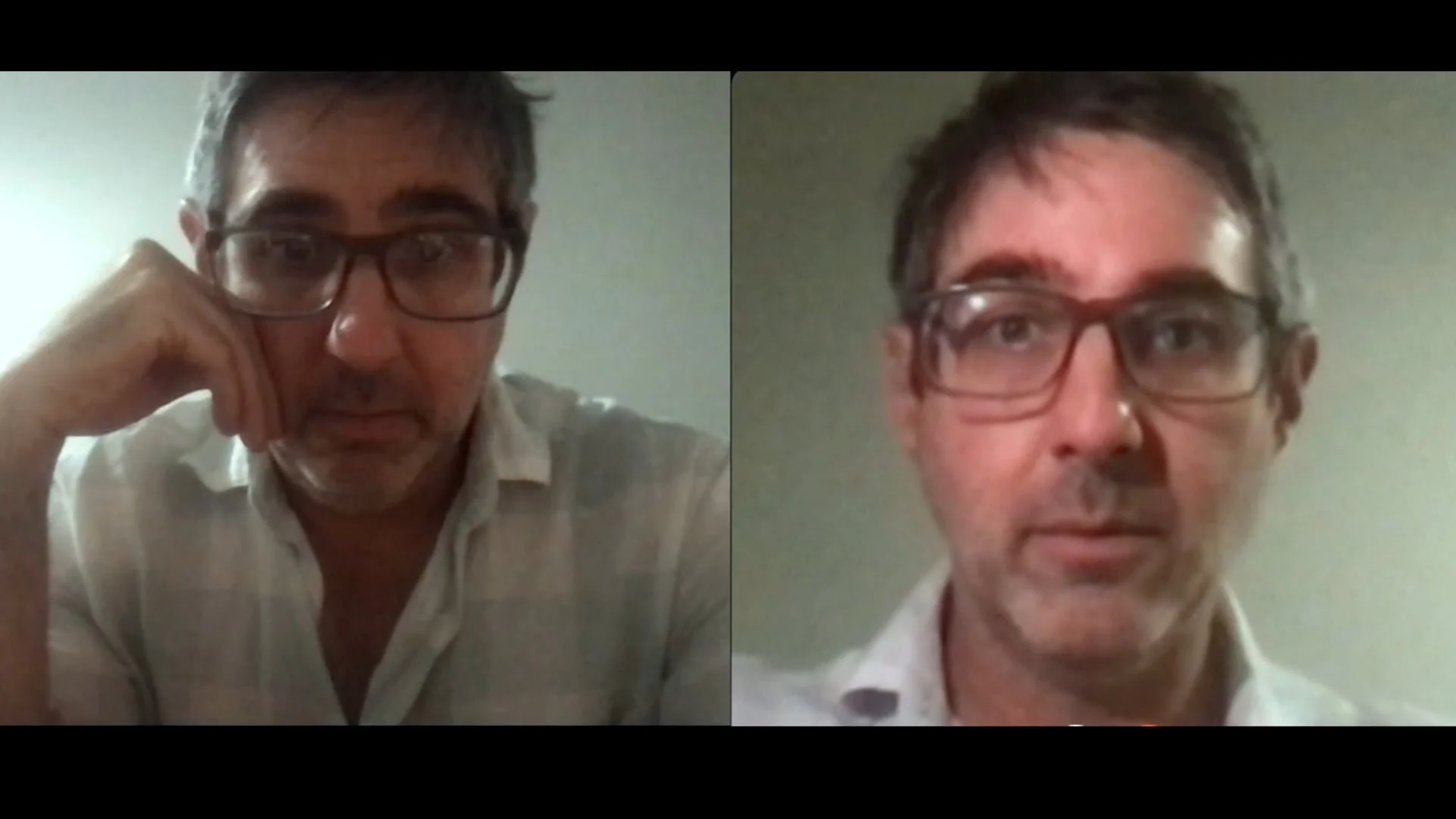
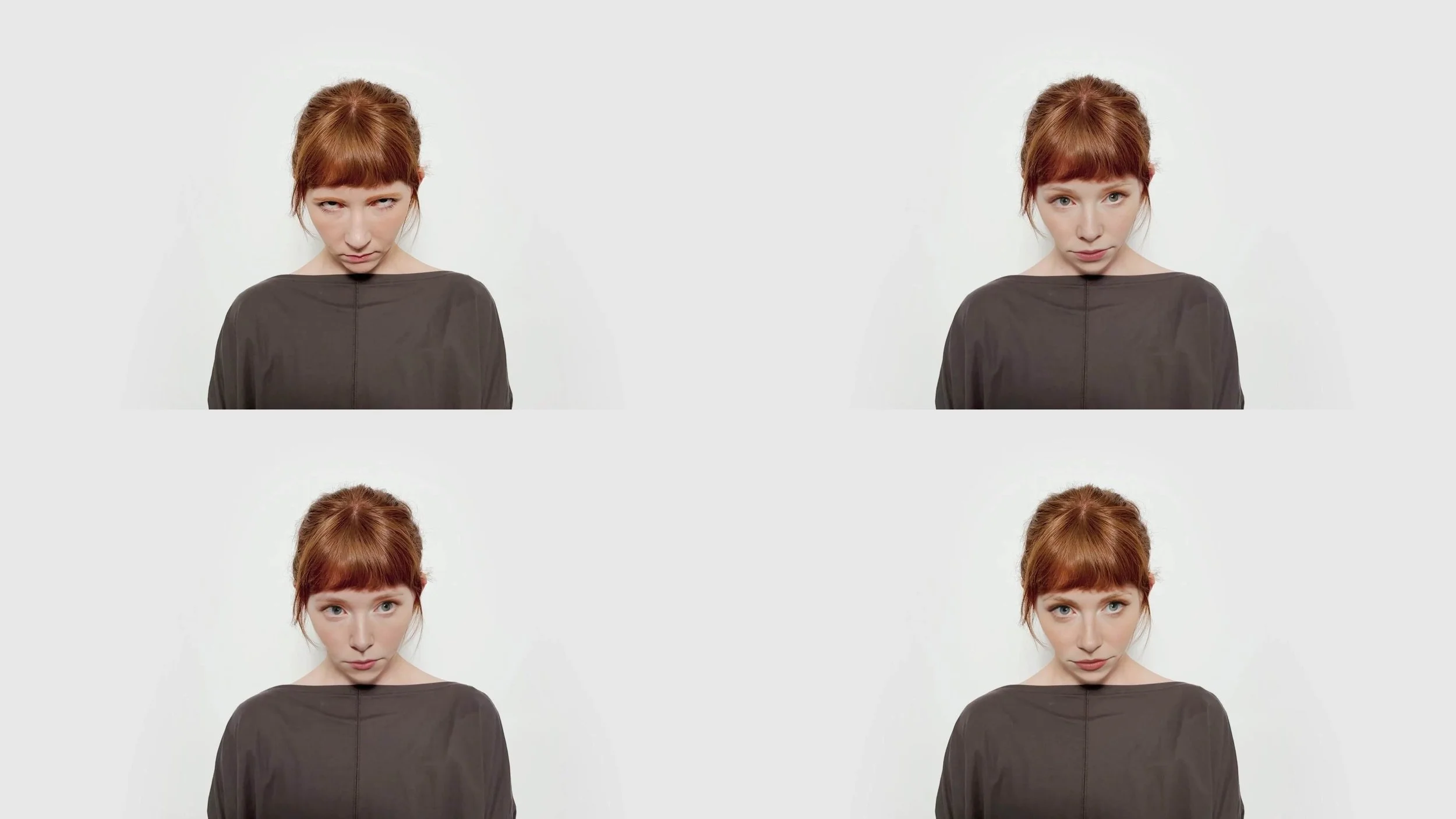
"Interview" is a video work framing a dialogue between myself and my digital double, a deepfake AI trained on my image and voice. I initiate an absurd call-and-response using variations of the paradoxical phrase, “I am your doppelgänger. I am not you. You are my doppelgänger.” In response, the double strains to recall my words, its performance failing through uncanny blinks and vocal stutters.
Artist Bio:
Michael Mersereau (b. 1977) is an interdisciplinary artist based in Durham, North Carolina He explores the boundaries of cinema and television genres, including horror, suspense, and soap operas, to create experimental sound, video, performance, and installations that elevate specific film production elements, resulting in absurd and uncanny worlds. Mersereau has exhibited internationally at museums and galleries such as Cordoba Lab, Museo de Arte Contemporáneo de Oaxaca and Oaxaca Graphic Arts Institute in Oaxaca de Juarez, Mexico; The Diego Rivera Anahuacalli Museum in Mexico City; Eastern Bloc and Maison de la Culture Claude-Léveillée in Montréal, Canada; and Wassaic Projects in New York State. His videos have been screened at the Lausanne Underground Film Festival, The Torrance Art Museum in Los Angeles California, Traverse Video Festival, and ARoS Aarhus Kunstmuseum in Denmark. He has performed at The Lab in San Francisco, Galerie B312 in Montréal, Sala Elia in Oaxaca de Juarez, Mexico, and Mills College Art Museum with choreographer and dancer Molissa Fenley. Mersereau plays guitar, electroacoustic music and Expanded cinema. He holds an MFA from Mills College and a BFA from California College of the Arts.
Time to Wake up // Freya Björg Olafson
Project Statement:
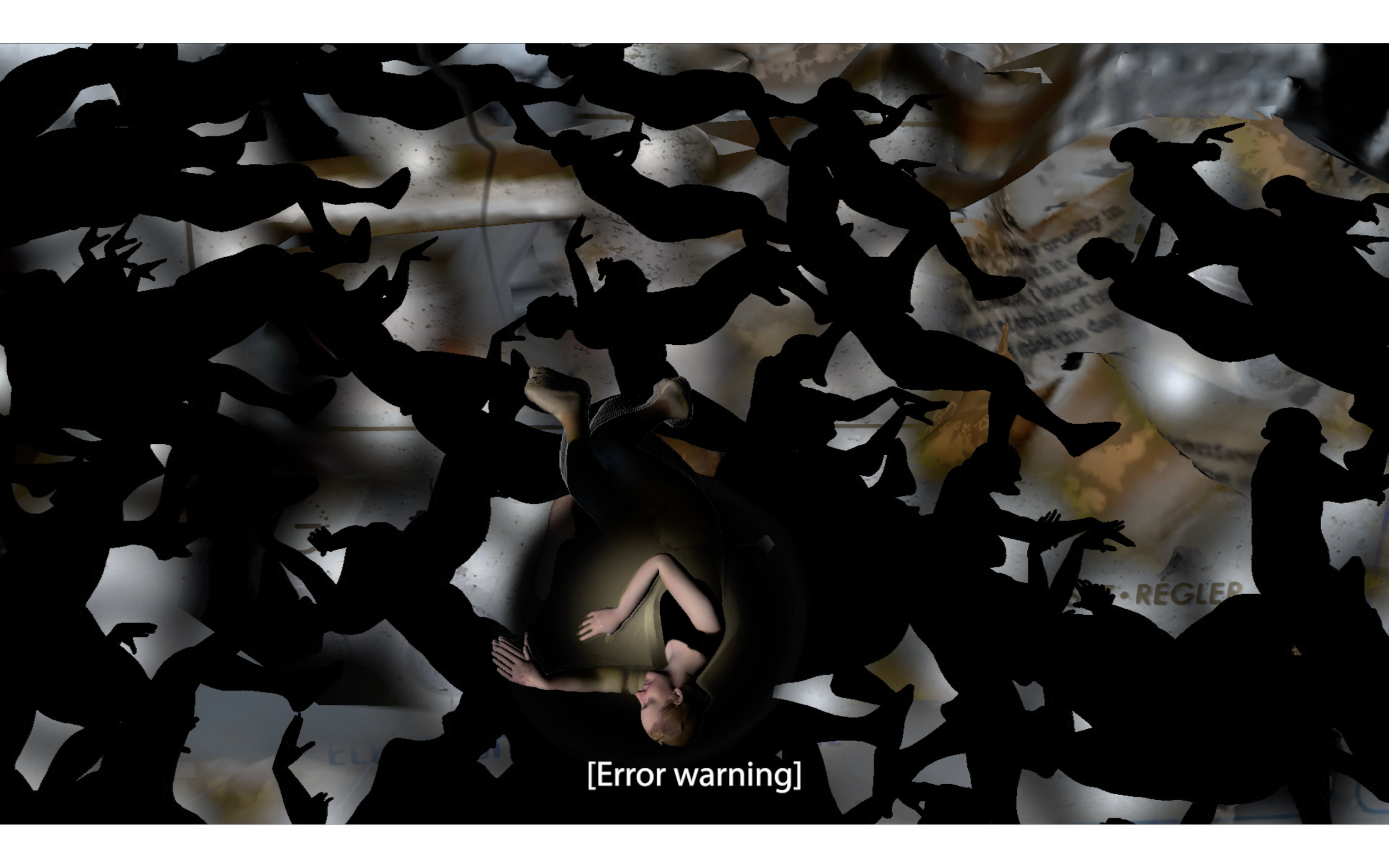
In this machinima video work, 3D avatars of Freya are animated using AI-generated motion capture, choreographed through text prompts with SayMotion. Freya’s avatars move through an environment composed of 3D LIDAR scans from two personal archives: the exterior of Freya’s studio/live space (2006–2023) and performance materials from Tedd Robinson’s archive—a monologue printed across pieces of canvas and bells strung along two ropes with handles.
Freya’s engagement with Tedd Robinson’s archival materials began through MULTIPLES, a collective process initiated in 2023 through Ten Gates Dancing Inc., following Tedd’s passing in 2022. Tedd Robinson (1952–2022) was a Canadian choreographer, performer, and educator, renowned for his distinctive solos alongside many collaborative works. He was an essential mentor and advisor on Freya's works AVATAR (2009), CPA [Consistent Partial Attention] (2013), and MÆ - Motion Aftereffect (2019). Tedd continually questioned the role of archives—not as static repositories, but as living entities that renew, regenerate, and connect across generations.
This video considers the potential of moving images, 3D scans, code, motion capture, and avatars as digital archival tools that support and expand how dance and choreography are experienced, created, taught, documented, shared, archived, and remembered. The work blends virtual camera footage from Freya’s game environment with real-life video, including footage of Freya’s child, Ylfa, ringing Tedd’s bells and a cockroach in Freya’s oven. By bridging personal scans and video with the artifice of AI-generated movement, the work explores the intersections of beginnings and ends, birth and legacy, presence and preservation—to consider how dance and choreography will exist 50 years from today in light of sociopolitical and technological change concurrent to environmental degradation.
Artist Bio:
Freya Björg Olafson is an intermedia artist who works with video, audio, animation, motion capture, XR, painting, and performance. Olafson has exhibited and performed internationally at the Bauhaus Archiv (Berlin), Ochoymedio (Ecuador), LUDWIG museum (Budapest), and Reykjavík Art Museum / Sequences Real Time Media Arts Festival (Iceland). Olafson has benefitted from residencies, most notably through EMPAC - Experimental Media & Performing Arts Center (New York), Oboro (Montreal), and Counterpulse (San Francisco). Previous awards and recognitions include the Buddies in Bad Times Vanguard Award for her work AVATAR in 2010, becoming a ‘Sobey Art Award’ longlist awardee in 2020, as well as being selected for the 'Lumen Prize for Art & Technology' longlist in 2021 and receiving the OFFTA Prize in 2025 for her work Olafson’s work "MÆ- Motion Aftereffect". In 2021, Olafson’s solo performance ‘AVATAR’ (premiered in 2009) was published as a score / script for Playwrights Canada Press’ anthology on digital theatre. Olafson has written a short chapter about virtual animation and motion capture techniques in ‘MÆ-Motion Aftereffect’ that will be published in the Bloomsbury Encyclopedia of Animation Studies in late 2025. In 2024, Olafson collaborated as movement director with seven dancers, five from The Royal Winnipeg Ballet and two independent artists, for Noam Gonick’s project 'Regulation of Desire', a five-channel video installation commissioned by the Canadian Museum of Human Rights / LGBT Purge Fund; The work is currently on view until February 2026. From 2017 - 2021, Olafson was Assistant Professor in Screendance within the Department of Dance at York University in Toronto. Since July 2021, Olafson has been an Assistant Professor in Digital Media at the University of Manitoba School of Art. Olafson holds an MFA in New Media from the Transart Institute / Donau Universität.
Portrait of an Average Woman // Dana Potter
Project Statement:
In this video the artist performs and AI generated avatars mirror her motion. The AI performers are generated from the artist's likeness. The motion is choreographed to from an augmented reality avatar in Meta Spark Studio.
Artist Bio:
Dana Potter is an educator, user experience designer, media artist, and printmaker. Potter is a first year faculty at the Hite Art Institute, University of Louisville, teaching as an Assistant Professor of Graphic Design, Interaction Design. For six years, Potter has worked as the Senior User Experience Designer for Fortepan US, a national public resource for vernacular photography. Potter is also the graphic designer for and co-coordinator of Open Air Media Festival, an outdoor media arts program. As a studio artist her work investigates the mechanics, visualizations, and applications of biometric technologies including eye-trackers, computer-mouse movement recordings, and facial recognition. She received her Master of Fine Arts in Printmaking from the University of Knoxville. Her artworks have been exhibited in competitive national and international exhibitions including “2024 Screen-print Biennial” Chico, California and Troy, NY; “Celebrate Print Exhibition” Lawrence Art Center 2023; “2017 Beyond Printmaking 5,” Texas Tech University, Lubbock, Texas; and “Stand Out Prints 2016,” Highpoint Center for Printmaking, Minneapolis, MN. She has attended residencies at the Morgan Papermaking Conservatory in Cleveland, Oh; The Eugeniusz Geppert Academy of Art and Design in Wrocław, Poland; and Arts Quarter Budapest, Budapest, Hungary.
Vorkurs // Drew Sisk
Artist Bio:
Drew Sisk is Assistant Professor of Graphic Design at Clemson University. His research blurs the lines between fine art and graphic design, using live web-based work, installation, and print media as ways to critically explore the conjunction of media, politics, and technology. His artists’ books and publications are included in collections at the Yale University Hass Arts Library Special Collections and the Joan Flasch Artists' Book Collection at the School of the Art Institute of Chicago (SAIC), among others. Previously he worked in visual identity design and branding at EM2 in Atlanta and in publishing design at Duke University Press. He earned his MFA in Graphic Design at Virginia Commonwealth University in 2018 and his BA in Studio Art and Asian Studies at Furman University in 2010.
Project Statement:
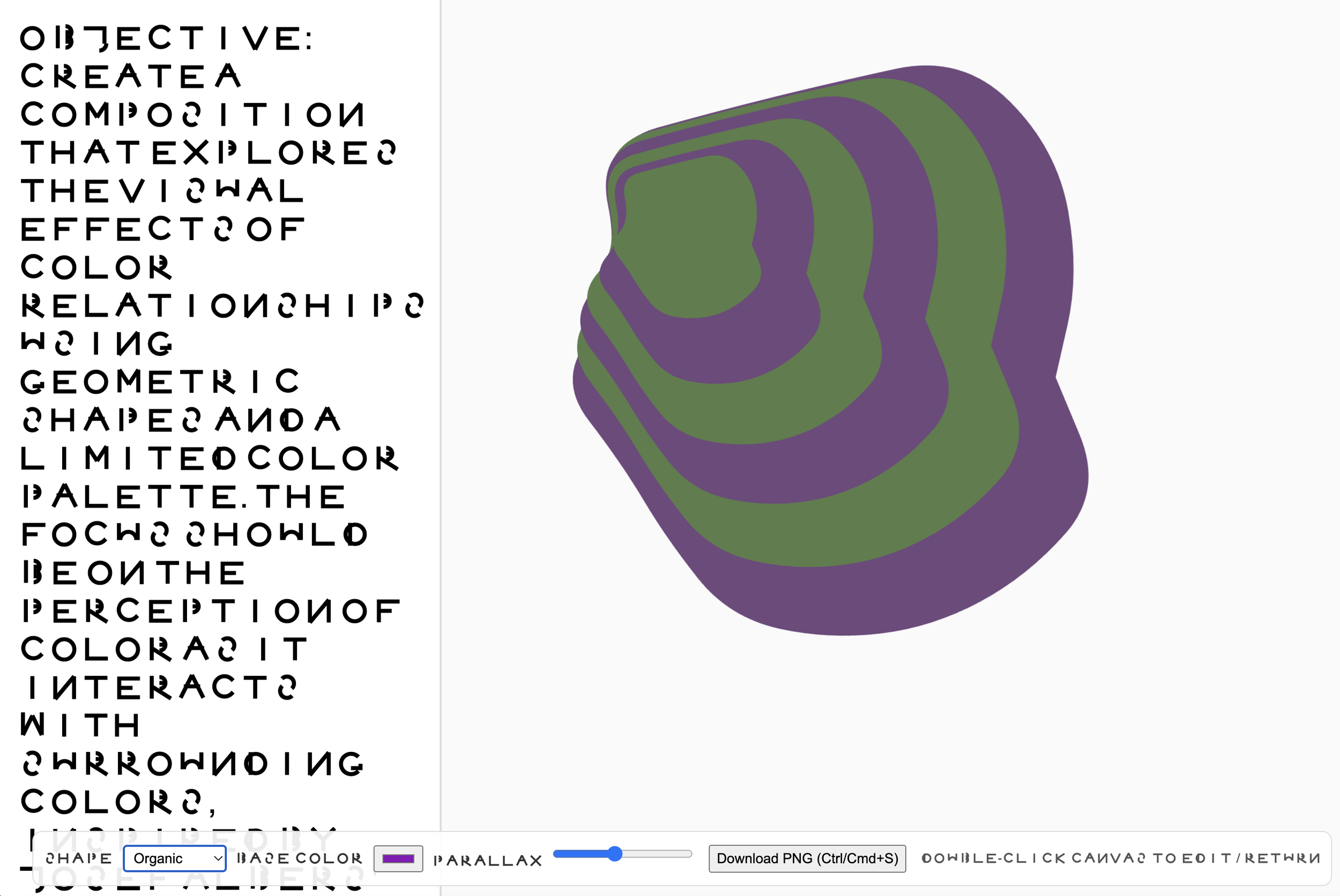
This interactive piece is part of a body of research in which I trace the footsteps of the faculty members of the Bauhaus who fled Nazi Germany to help launch Black Mountain College in the 1930s. I see parallels to the present, in which our access to and understanding of art and design history and our cultural memory face the dual threats of rising global fascism and an archive compromised by AI.
I am interested in the correlation between the training we receive as artists and designers in foundations courses and the “training” AI models rely on to generate images and texts. This piece was constructed with several AI tools, yielding both a working typeface and an interactive web interface. The website prompts users to create a composition in the style of Josef Albers. Users find themselves in a loop of human and AI creative output.
While AI undoubtedly problematizes cultural memory and production, it can also be used to critically engage our current moment, exposing the absurdity and banality of these newly-accessible technologies. From the Bauhaus, Josef and Anni Albers brought the Vorkurs, the curriculum for an art foundations course in which students would learn basic material properties. Josef Albers referred to his basic design curriculum using the German word Werklehre, focusing on economy of means and using “well-known materials [to] seek to find untried possibilities.” In this way, artificial memory and digital gestures become materials for experimentation in a new era of human-machine collaboration.
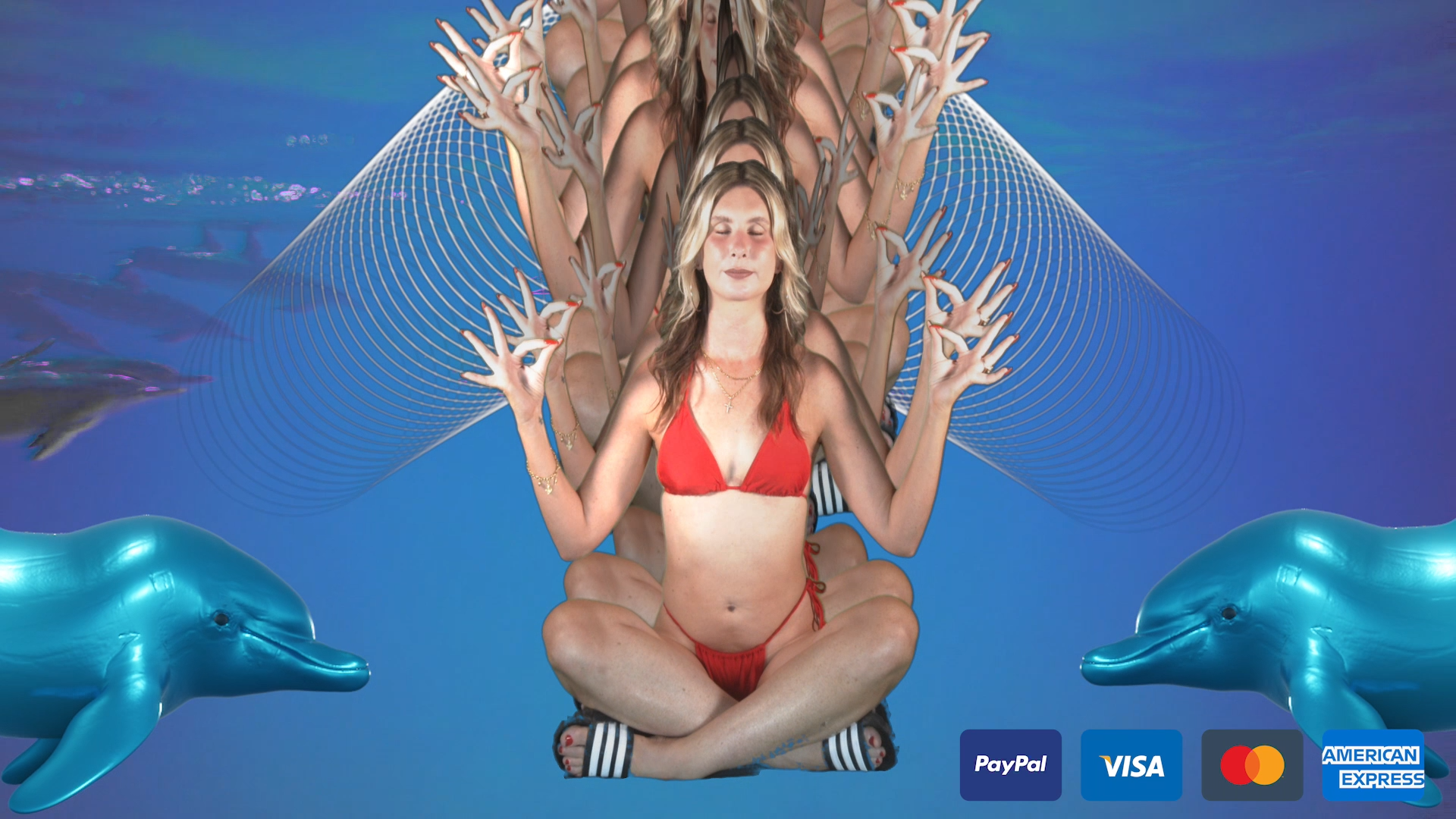
dolphin connection: mvmnt 1 // Sarah Turner
Project Statement:
mvmnt 1 of new video opera, dolphins, aliens, & angels, by sarah sarah turner turner. sarah downloads S.O.N.A.R,. an AI Dolphin, to seek answers to the universe. S.O.N.A.R. guides sarah through a sonic and visual meditation to help her find the answers she seeks.
<This content is all artist generated. It only emulates personal experiences with AI research and exploration>
Artist Bio:
Sarah Turner is a new media and video artist who creates large scale immersive environments and performances through analog media and creative coding. She engages in ritual and contemporary mythologies to augment reality through performative psycho spiritual activations and explorations of the absurd. Her work has been shown at Ann Arbor Film Festival, Meow Wolf, Portland Art Museum, Wieden + Kennedy, Portland Institute for Contemporary Art’s TBA Festival, Athens Digital Arts Festival, Northwest Film Center, Spaceness Festival, Marfa Open Festival, Laboratory Residency and more. Turner received an MFA at Alfred University in Electronic Integrated Art. She is a Video Designer at Meow Wolf, Inc.
https://www.sarahsarahturnerturner.com/ @sarahsarahturnerturner2